Home Blog LTM Revenue (and EBITDA) in 3 Steps – The Ultimate Guide
Finance...In Plain English / 10 min read
LTM Revenue (and EBITDA) in 3 Steps – The Ultimate Guide
Author
Mike Kimpel
featured
Table of Contents
Introduction Student success
Learn to calculate LTM Revenue and EBITDA (or TTM Revenue and TTM EBITDA) like a pro so you can use it on the job in Investment Banking, Private Equity, and Investment Management.
In this article, you’ll see:
Why Finance professionals use LTM Revenue and EBITDA Calculations.
The 3-Step Process for calculating LTM Revenue and EBITDA.
Examples of calculations for Uber (LTM Revenue) and Coinbase (LTM EBITDA).
On-the-job use cases for Investment Banking and Private Equity Professionals.
TL;DR
Last Twelve Month (‘LTM’) calculations help us see the most recent year of Financial performance and can be completed with a 3-Step Process detailed below.
LTM Revenue and EBITDA are widely used across the Finance world.
LTM and Trailing Twelve Months (‘TTM’) are interchangeable terms.
Last Twelve Months calculations are far more useful in helping us understandpast performance, whereas Next Twelve Months (‘NTM’) provides insight into future performance.
What Does LTM Mean?
The term LTM stands for ‘Last Twelve Months.’
Finance professionals use LTM Calculations to analyze the previous full year of performance for a Business.
Analysts create LTM calculations because the regularly reported Financial dataonly reflects the prior twelve months of data once per year (right after the Annual Report).
The LTM calculation is distinct from the most recent full-year (‘Fiscal’ or ‘Calendar’ Year) or prior three months (‘Quarterly’) data.
Two of the most commonLTM calculations are LTM Revenue and LTM EBITDA. We’ll show examples of how to calculate both in this article.
Before we dive into why LTM usage is so widespread, let’s quickly clarify LTM vs TTM.
Frustratingly, in the Finance world, we seem toneed multiple terms for everything.
The numerous interchangeable terms often cause massive confusion for newcomers. LTM calculations are no exception.
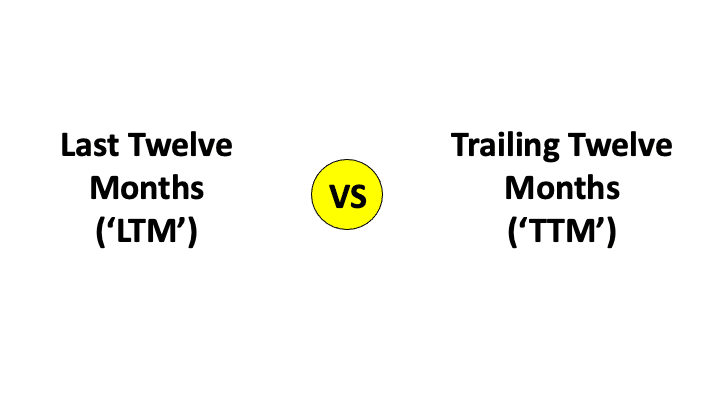
As we mentioned before, LTM stands for ‘Last Twelve Months.’
However, there’s another term for this same concept which is TTM or ‘Trailing Twelve Months.’
While LTM is more common in our experience, TTM is pretty widespread and means the exact same thing as LTM.
So, if someone asks you to calculate TTM Revenue, it’s the same calculation as LTM Revenue.
Why Use LTM Revenue and EBITDA?
When analyzing a company, you’ll want to see the Company’s most up-to-date performance.
While Quarterly data can be helpful, some companies have significant fluctuations in their Businessin particular quarters within each year.
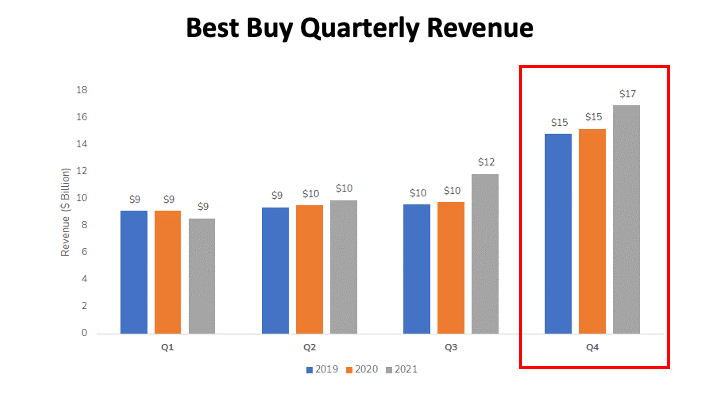
As an example, let’s look at a Retail Business like Best Buy.
As you can see above, the fourth quarter (i.e. the Christmas Holidays) generates a significant portion of annual Revenue.
If we only looked at the fourth quarter for Best Buy, we’d see a VERY distorted picture.
Because of fluctuations like this within each year, we typically want to see a full year of Financial data. This is where LTM Revenue would be very helpful.
If Companies reported a full year of Financial data with each Quarterly Report, the concept of LTMwould not exist.
However, most companiesreport 12 months of data once per Year and Quarterly datathree times per year.
As a result, we can only see the prior twelve months of performance for the 3 months after the Annual Report (or 10K Filing in the US).
As we’ll see in the next section, an LTM calculationallows us to see the previous 12 months of performance at any pointin the year.
LTM Revenue and EBITDA Calculations in 3 Steps
To calculate any LTM metric, we follow the simple, 3-Step Process below:
How to Calculate LTM Revenue (or LTM EBITDA) in 3 Steps
Find the Latest Annual Financial data. Pull the most recent Annual data from the latest Annual Filing (typically the 10-K Filing in the US).
Add the latest Year-To-DateFinancial data. Pull the most recent YTD data from the latest Quarterly Filing (typically the 10-Q Filing in the US).
Subtract the Year-To-DateFinancial data for the same period in the prior year. Pull the prior year YTD data from the latest Quarterly Filing (typically the 10-Q Filing in the US).
With this calculation, we can quickly compute the latest Twelve Months of data at any point in the year.
Below we’ve included a simple, visual example of an LTM calculation on a timeline so you can more easily see how each of the pieces from the steps above come together.
Now let’s look at a few real-life LTM calculations!
LTM Revenue and EBITDA Examples: Uber and Coinbase
We’ve explained LTM at a high level. Now, let’s walk through a couple of LTM calculations in action for Uber and Coinbase.
These examples will help you understand how to source the data needed to calculate LTM Revenue and LTM EBITDA.
Example: How To Calculate LTM Revenue for Uber
Let’s imagine that we want to calculate the LTM Revenue for the ridesharing business Uber.
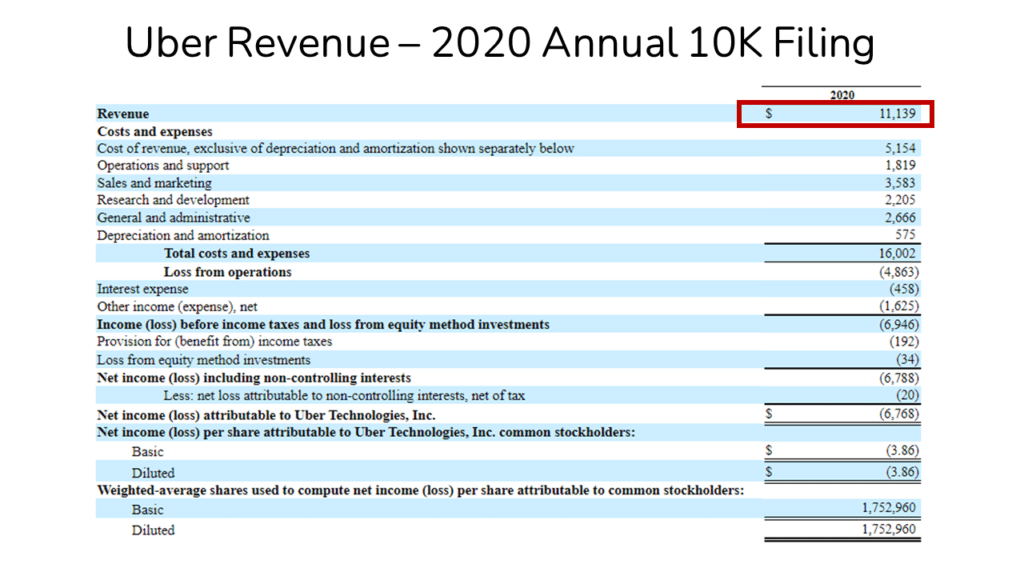
To calculate LTM Revenue, we’d begin by finding the Company’s latest Annual Revenue in Uber’smost recent 10-K filing.
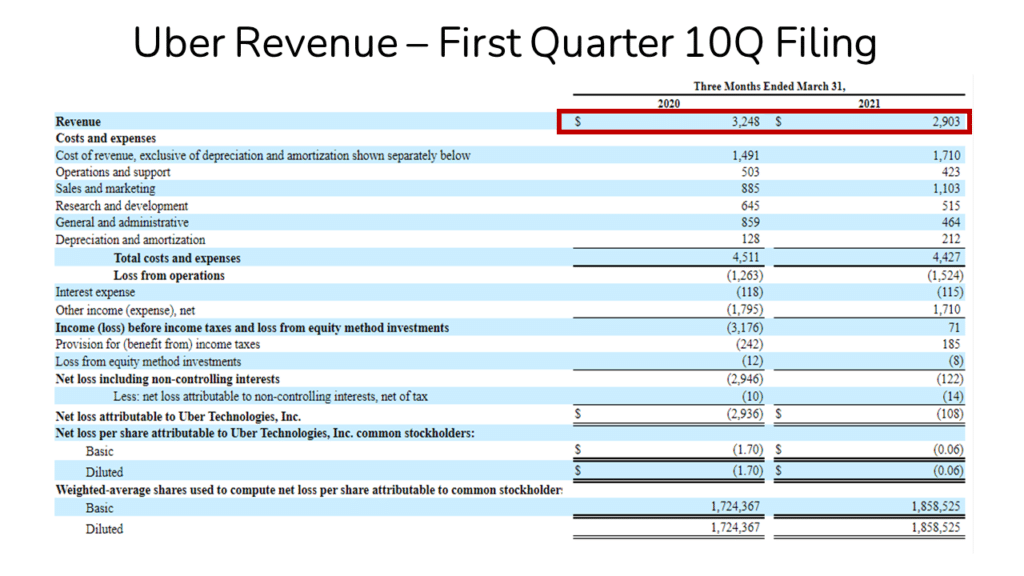
Now that we’ve found both of these items, we can complete the LTM Revenue Calculation for Uber.
In this example, Uber’s LTM Revenuedeclined slightly to 3% below the latest Annual Revenue.
Example: How To Calculate LTM EBITDA for Coinbase
Let’s now imagine that we want to calculate the LTM EBITDA for the Cryptocurrency Exchange Platform Coinbase.
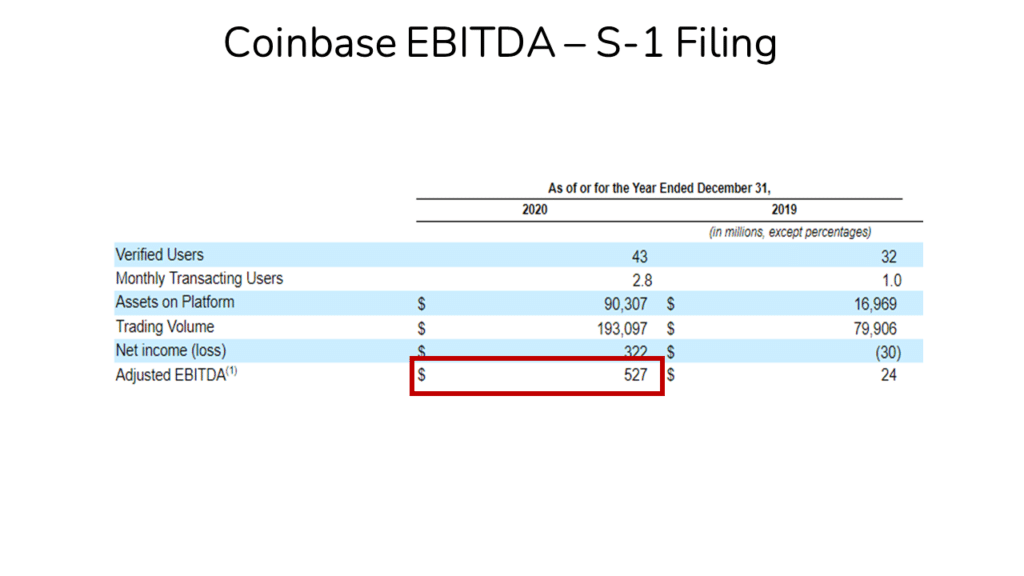
We’d begin by finding the Company’s latest Annual EBITDA in Coinbase’s S-1 Filing.
Note: We are only pulling from the S-1 filing in this case because Coinbase just went public in April 2021. As a result, the company hasn’t yet published a 10K filing.
In this example, Coinbase’s LTM EBITDA increased significantly to 202% higher than the latest Annual EBITDA.
Examples of LTM Calculations in Real Life
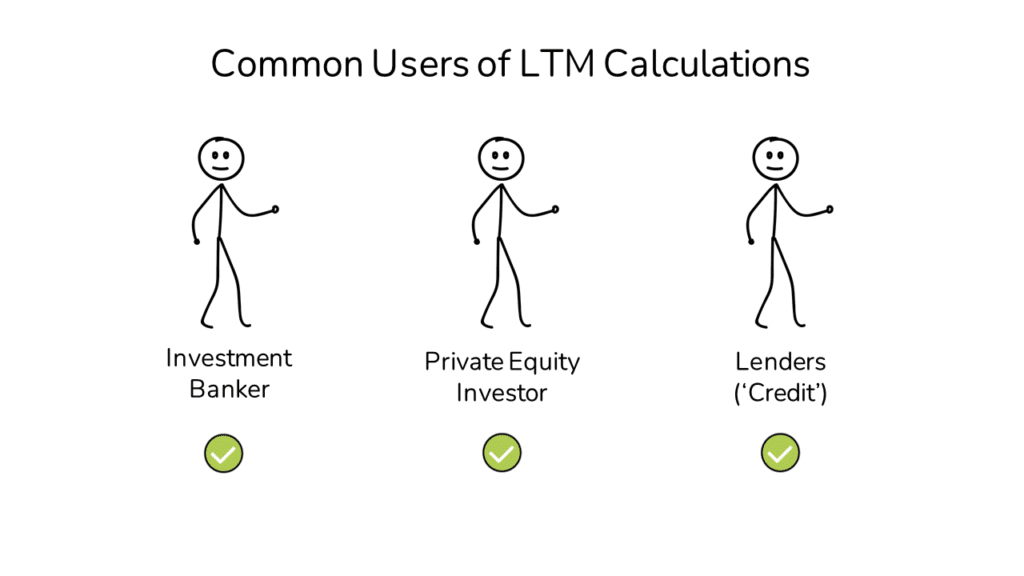
Finance Professionals across Investment Banking, Private Equity, and Lending (or ’Credit’) use LTM Revenue and LTM EBITDA metrics every day.
In the sections below, we will cover a few real-life use cases for LTM Revenue and LTM EBITDA.
Investment Banking Use Case: EV / LTM EBITDA
Nearly every Investment Bank has a Mergers and Acquisitions (or ‘M&A’) advisory offering. In M&A, Bankers advise their Clients on the Valuation of their Clients’ Businesses.
One of the most commonly used metrics for Valuation in Investment Banking is the Enterprise Value / LTM EBITDA (or EV / LTM EBITDA) Multiple.
This particular multiple is one of the most typical multiples for Acquisition Analysis.
By looking at the Last Twelve Monthsof EBITDA, the Bankers can create a Valuation Multiple that incorporates the Company’slatest Financial performance.
What is Enterprise Value?
Very briefly, Enterprise Value represents the Purchase Price of the entireBusiness. And it’s common to look at Enterprise Value relative to the Last Twelve Months of EBITDA.
How an Investment Banker would use EV / LTM EBITDA
An Investment Banker would typically calculate the EV / LTM EBITDAMultiple for several peer companies.
The banker would then apply the Peer EV / LTM EBITDA Multiple to the Client company’s EBITDA to determine the appropriate sale Valuation.
Private Equity Use Case: Debt / LTM EBITDA
Traditional Private Equity (i.e. ‘Leveraged Buyout’ or ‘LBO’) firms make acquisitions using Debt.
The level of Debt that they can raise is typically expressed as a multiple of Debt to LTM EBITDA (or Debt / LTM EBITDA).
Let’s say Lenders are willing to offer5 Times (or ‘5x’) Debt / LTM EBITDA.
We could then calculate LTM EBITDA to determine the level ofDebt that could be raised to fund the LBO transaction.
Let’s say our Acquisition Target generates $100 million of LTM EBITDA.
In that case, the Private Equity firm could raise $500 million ($100 million LTM EBITDA * 5x Debt / EBITDA) of Total Debt to fund the Acquisition.
Why do Lenders use Debt / LTM EBITDA?
Debt / LTM EBITDA is the go-to metric for Lenders in Private Equity transactions.
LTM data helps them see the latest Year of EBITDA performance for the Companyto lend their money.
Lenders can weigh the latest year of EBITDA against the Debt (i.e. Interest)burden the Company will bear after money is lent.
LTM Reflects the Past and NTM Reflects The Future
LTM Revenue and EBITDAtell us what happened in the past.
Lenders to Private Equity deals focusprimarily on past performance (or ‘Creditworthiness’) to ensure they will be repaid. As a result, LTM metricsdominate the Debt world.
On the other hand, LTM metrics do not offerinsightinto what will happen in the future.
As a result, LTM Revenue and LTM EBITDA are not nearlyas commonly used in Investment Management.
Equity funds are looking to generate returns based on future results.
As a result, they tend to focus on the future performance, which is captured byNext Twelve Months (or ‘NTM’) Revenue and EBITDA.
Where Can I Find NTM Financial Data?
Equity Research analysts create estimatedNTM financials for the Companies they cover. The Analysts then submit their estimates to aggregators like FactSetand Bloomberg.
Individual Investorscan find these metrics on Koyfin, an aggregator that offers the same information but for free.
These aggregators then publish the average (or ‘Consensus’) of all the estimates submitted, which are used to create EV / NTM Revenue and EV / NTM EBITDA multiples.
Wrap-Up: LTM Revenue (and EBITDA)
Hopefully, you have a much better understanding of both the LTM Calculation Process and the underlying idea behind LTM Calculations.
LTMmetrics are widely used throughout the Finance world, and you can follow our 3-StepProcess to calculate LTM Revenue, LTM EBITDA, or any LTM metric.
Let us know if you have any questions in the comments below. We’d love to hear from you!
Who the core players are in the Finance world and howthey operate.
Core mental frameworks for learning Valuation and ReturnsAnalysis.
Reviews of common trouble topics based on our experience training thousands of students.
Detailed walkthroughs of common Interview Questions.
About the author
Mike Kimpel is the Founder and CEO of Finance|able, a next-generation Finance Career Training platform. Mike has worked in Investment Banking, Private Equity, Hedge Fund, and Mutual Fund roles during his career.
He is an Adjunct Professor in Columbia Business School’sValue Investing Program and leads the Finance track at Access Distributed, a non-profit that creates access to top-tier Finance jobs for students at non-target schools from underrepresented backgrounds.
Frequently asked questions
How do you Calculate LTM Revenue?
To calculate LTM Revenue, we: 1) find the Latest Annual Financial data 2) then add the latest Year-To-Date Financial data, and 3) Subtract the Year-To-Date Financial data for the same period in the prior year.
What is LTM in Finance?
LTM (or ‘Last Twelve Months’) calculations reflect the most recent Twelve Months of Financial performance and have various applications in the Finance world across Investment Banking, Private Equity, and Investment Management.
What does LTM stand for?
LTM stands for ‘Last Twelve Months,’ and it refers to calculations that show the most recent Twelve Months of Financial performance (e.g. LTM Revenue and LTM EBITDA).
What is TTM?
TTM stands for ‘Trailing Twelve Months’ and it refers to calculations that show the most recent twelve months of Financial performance (e.g. LTM Revenue and LTM EBITDA). The term is interchangeable with LTM or ‘Last Twelve Months’.
What does TTM mean? or What’s TTM mean?
TTM stands for ‘Trailing Twelve Months’ and it refers to calculations that show the most recent Twelve Months of Financial Performance (e.g. TTM Revenue and TTM EBITDA).
What is LTM and NTM?
LTM stands for ‘Last Twelve Months’ and reflects the most recent Twelve Months of Financial performance. NTM stands for ‘Next Twelve Months’ and reflects a Business’s estimated Financial performance for the upcoming Twelve Months.
Is LTM and TTM the same?
LTM (or ‘Last Twelve Months’) and TTM (‘Trailing Twelve Months’) are interchangeable. Bothreflect the most recent Twelve Months of Financial performance for a Business.
What is LTM Revenue? What is TTM Revenue?
LTM Revenue and TTM Revenue are interchangeable terms. Both reflect the most recent Twelve Months of Revenue generated by a Business.
What is LTM EBITDA? What is TTM EBITDA?
LTM Revenue and TTM EBITDA are interchangeable terms. Both reflect the most recent Twelve Months of EBITDA generated by a Business.
What is EV / LTM Revenue?
EV/LTM Revenue is a commonly used Valuation Multiple that looks at the Purchase Price (‘Enterprise Value’ or ‘EV’) of the entire Business relative to the last twelve months (‘LTM’) of Revenue generated by the Business.
How to calculate LTM EV / EBITDA?
EV/LTM EBITDA is a commonly used Valuation Multiple that looks at the Purchase Price (‘Enterprise Value’ or ‘EV’) of the entire Business relative to the last twelve months (‘LTM’) of EBITDA generated by the Business.